Villarejo de Salvanés
Villarejo de Salvanés, echoes of Lepanto
When Luis de Requesens, the Major Commander of Castile at the time, promised the Virgin in 1571 that he would order the construction of a convent if the Holy League defeated the Ottoman Empire at the Battle of Lepanto, he decided that said convent would be in Villarejo de Salvanés.
Villarejo de Salvanés was the site of the Encomienda Mayor de Castilla at the time. And it had three centuries of history behind it since, in the middle of the 13th century, the Order of Santiago decided to found this town, probably taking advantage of the existing old watchtower. There is no doubt today that the most emblematic site in Villarejo de Salvanés is its castle. It’s the best witness to its history and the best example of this kind of structure one can find. The primitive building, erected by the Order of Santiago, underwent several significant reforms between the 15th and 16th centuries, until it became the stately fortress seen standing today.
People began settling around this defensive structure which was used to protect the septentrional entry into the Order’s territories on the Southern Meseta. This enclave with a marked Castilian atmosphere is also home to a few other outstanding structures such as the Casa de la Tercia, the church of San Andrés and, of course, the aforementioned Sanctuary and Convent of Nuestra Señora de la Victoria.

Castillo de la Orden de Santiago, Villarejo de Salvanés
El Castillo, cuyo primer recinto se construyó a finales del siglo XIII, y al que posteriormente se le fueron añadiendo edificios, tenía un marcado carácter defensivo y entre sus principales elementos se encontraban la fortaleza, el palacio, el foso y la torre. De la fortaleza original, hoy solo queda una pequeña parte: la torre del homenaje y los cimientos recuperados gracias a excavaciones arqueológicas. Desde la torre se divisa todo el territorio circundante, al atardecer la puesta del sol sobre los páramos de las alcarrias madrileñas es todo un espectáculo.
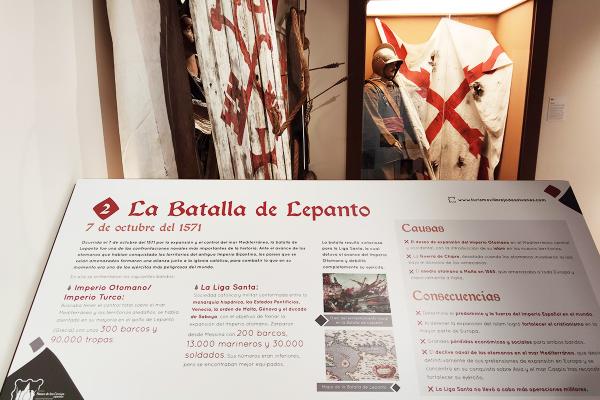
En el interior de La Torre encontramos el Museo de los Tercios Españoles, la historia del municipio y de su Castillo enmarcada dentro de la historia de España. Entendemos la misión y protagonismo de las órdenes militares, y en concreto la presencia de La Orden Militar de Santiago, a la que se le fueron atribuidas estas tierras.

Casa de la Tercia
The agricultural past of Villarejo de Salvanés, the result of its location between the fertile plains of the Tagus and Tajuña rivers, is displayed in the ethnographic museum of the Casa de la Tercia, a 15th century building built by the Military Order of Santiago. The Casa de la Tercia was built during the period in which Juan de Zúñiga y Avellaneda was Major Commander (1534-1545). Visitors are welcomed by the Hapsburg royal coat of arms and, further down, the two coats of arms of the Zúñiga-Avellaneda family. The Casa de la Tercia is a wonderful example of austere, sombre and large-sized Castilian civil architecture where functionality is more important than the decor.
Once a winery, now an ethnography museum. The collection comprising it is directly associated with the objects with which the residents of Villarejo de Salvanés have been doing their farming work from the 15th century to our times.

Iglesia San Andrés Apóstol (Church of Saint Andrew the Apostle).
The San Andrés Apóstol church was built in the XIVth century, using a previous construction. It has undergone several transformations and reforms, but its outer part has preserved the appearance of a church-fortress, typical of military orders. Interesting coats of arms have survived in time on its façade, such as that of the Military Order of Santiago or that of the Council of Orders.

Convento de Nuestra Señora de la Victoria (Convent)
Visiting Villarejo de Salvanés is a real encounter with History. The temple of the patron saint of Villarejo de Salvanés is related to one of the most outstanding episodes in the history of Europe: The Battle of Lepanto, fought to prevent the advance of the Ottoman Empire through the Mediterranean in the year 1571.
Luis de Requesens, Major Commander of Castile, and lieutenant of John of Austria in Lepanto, promised that if the Christian forces were to achieve victory, he would build a temple in gratitude to the Virgin. And he made good on his promise.
Otros imprescindibles que ver en Villarejo de Salvanés
Si lo tuyo es conocer los destinos a fondo, no te pierdas otros imprescindibles de Villarejo de Salvanés como:

The Old Hospital
The old hospital is a typical 18th century functional structure. The elegant building revolves around a central courtyard much like a vaulted cloister with runners at two heights. The entrance is through a small limestone door over which there is a balcony framed within a lovely facade. Although a “hospital for the poor” is known to have existed in the 16th century, this building was erected in the second half of the 18th century.

The Pozo de San Marcos and Cañuelo fountains and washing places.
The Pozo Marcos fountain and washing place is situated outside the urban centre at the foot of the San Isidro chapel. It was used as a watering hole for livestock and as a washing place as well as water supply point for the locals. Built in the 18th century, it has two pipes that drain into a large “L” -shaped basin that flows into a large laundry room. The entire site was built with limestone blocks between the 19th and 20th centuries. The El Cañuelo fountain and washing place is also situated outside the urban area. It was built in 1776 and consists of a fountain made of limestone blocks with a semi-circular overflow excavated in the stone that leads the water through a channel to a rectangular drinking trough, also made of limestone. The washing place is partially built into the ground with stone walls and a mortar pit on the inside.
Tips for visiting Villarejo de Salvanés
Villarejo de Salvanés was declared a Heritage Site in 1974 due to the historical relevance of its monumental heritage comprised of the Casa de la Tercia along with the Church of San Andrés Apóstol and the keep tower which was a part of the Military Order of Santiago fortress. This tower is currently found at the tourism office and is the point where any route through the town should begin. Continue reading...
Much more at the Tourism Office
Visit us and we’ll tell you all you need to know

Tourism Office of Villarejo de Salvanés
Interpretation centre
The inside of the Keep Tower offers an explanation of the history of Villarejo de Salvanés, always set in the history of Spain and particularly focused on the era of the Christian reconquest: where and when Christian monarchs’ reconquest began against Arab Spain and what the role of the military orders was throughout. Visitors will also learn about key figures in each period and how the lordship system fell in Spain. These are the main glimpses into history offered by Torre de Villarejo de Salvanés. After learning about its incredible history, you can walk up the tower and reach the highest altitude at the castle, 22 metres. From there, you can get a bird’s eye view of Villarejo de Salvanés and feel the peace offered by the altitude. A village with rooftops, low house, narrow streets and fields, many many fields; that’s the view from the tower and it’s the best way to understand its reason for being.

Cinema Museum
This is the first Museum of Professional and Technological Cinema in Spain, located in the old Paris Cinema in Villarejo de Salvanés. It houses a large amount of cinematographic material spread over several rooms, as well as having interesting exhibitions of the seventh art on the agenda.
There you will find one of the most entertaining, fun and educational museums in the Community of Madrid. This is the first museum of professional and technological cinema in Spain in the old Paris cinema in the town.
In this Alcoran location, the history of cinema is shown through the devices and apparatus that made it possible and that came to be marketed as “RECREATIONAL PHYSICS” devices. Each one of them meant a step closer to achieving that moving image, known first as “ANIMATED PHOTOGRAPHY” and later simply as “CINEMA”.

Colmenar de Oreja and Villarejo de Salvanés: gastronomic and wine tourism centres
The greatest of the four sub-areas of the Designation of Origin “Vinos de Madrid” lies at the south-east of the Region of Madrid. We suggest to you to travel around two of the municipalities that are part of the Arganda sub-area. We will start our journey at Colmenar de Oreja and end at Villarejo de Salvanés. Both municipalities offer top quality food and wine tourism for visitors... Both enclaves offer much more. Continue reading...
Calendario de Fiestas y Eventos
Villarejo de Salvanés ofrece un calendario festivo variado a lo largo del año. Destacan las fiestas patronales de San Andrés Apóstol, con gran ambiente popular y numerosas actividades.
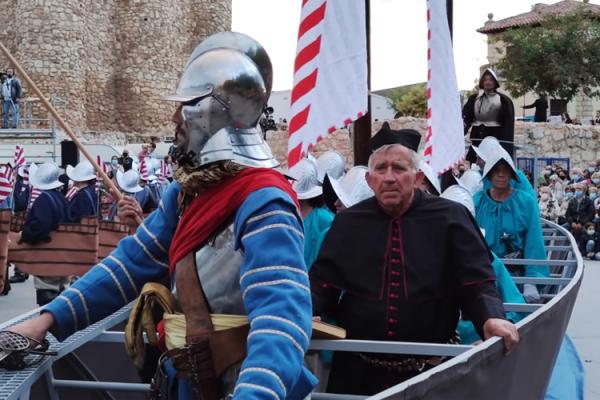
Entre sus citas más singulares se encuentra, a principios de octurbre, la Recreción de la Batalla de Lepanto, una recreación histórica que pone en valor su pasado vinculado a la Orden de Santiago, y la Pasión de Villarejo, una emotiva representación en Semana Santa.
Además, Agromadrid reúne cada año a productores y visitantes en torno a la gastronomía y las tradiciones rurales, siendo uno de los eventos más importantes del municipio.
Mantente informado de los eventos más importantes de la Villa en la Agenda Visitmadrid.
Gastronomía: ¿Dónde comer en Villarejo de Salvanés?

Hablar de la gastronomía en Villarejo de Salvanés es rendir homenaje al recetario alcarreño y castellano más auténtico, donde el aroma a guisos tradicionales y carnes en salsa guía al comensal hacia experiencias culinarias inolvidables regadas con su extraordinario Aceite de Oliva Virgen Extra de la D.O.P Aceite de Madrid. La experiencia de comer en esta joya de las Villas de Madrid tiene su epicentro en sus mesones históricos y casas de comidas, donde el cordero asado, las gachas y el conejo al ajillo son los grandes protagonistas junto al pan artesano de la localidad.
El privilegio de degustar estos manjares alcanza su máxima expresión al maridarlos con los reputados caldos de las bodegas locales bajo la D.O. Vinos de Madrid o al aderezar cada plato con su laureado "oro líquido", el preludio perfecto para descubrir su arraigada pastelería tradicional.
Este legado artesano cobra vida en sus dulces típicos de sartén, elaboraciones tradicionales que endulzan el paseo por sus plazas históricas y cierran con broche de oro cualquier banquete alcarreño.
Para garantizar una visita perfecta y descubrir todos los rincones donde saborear estos platos y dulces tradicionales, te recomendamos consultar el listado oficial de restaurantes de Villarejo de Salvanés, una guía imprescindible para elegir entre los establecimientos que mejor preservan la herencia culinaria y el producto local de esta encomienda con siglos de tradición.
Alojamiento: ¿Dónde dormir en Chinchón?

Dormir en Villarejo de Salvanés es la mejor forma de completar una inmersión total en la calma y el sosiego de esta villa histórica, permitiendo descubrir el encanto de sus plazas bajo la luz de los faroles cuando cae la noche. La oferta de alojamiento en la localidad destaca por su capacidad de fusionar el confort moderno con un entorno rural cargado de historia, ideal para quienes buscan desconectar del bullicio de la gran ciudad en un territorio que fue sede de la Encomienda Mayor de Castilla de la Orden de Santiago.
El privilegio de pernoctar en este entorno se extiende a una cuidada selección de casas rurales con encanto y apartamentos turísticos que ocupan edificaciones tradicionales rehabilitadas, muchas de ellas manteniendo la arquitectura castellana de la zona, sus vigas de madera original y acogedores patios interiores. Ya sea que busques un refugio tranquilo a pocos pasos del icónico Castillo y la Iglesia de San Andrés o una estancia relajada rodeada de olivares en los alrededores del municipio, la hospitalidad alcarreña garantiza una estancia inolvidable.
Para encontrar la opción que mejor se adapte a tus necesidades y asegurar tu reserva en los establecimientos más auténticos, te recomendamos consultar el listado oficial de alojamientos de Villarejo de Salvanés.
¿Cómo llegar a Villarejo de Salvanés?
Descubre como llegar y moverte por Villarejo de Salvanés fácilmente
Acceso por carretera
Para quienes viajen en coche, la principal vía de comunicación es la Autovía del Este (A-3), que conecta Madrid con Valencia. El municipio dispone de varios accesos directos, siendo las salidas 48 y 50 las más utilizadas para entrar directamente al casco urbano, a sus zonas residenciales o al área industrial. La fluidez de esta autovía permite situarse en el centro de la capital en un tiempo estimado de cuarenta minutos, enlazando también de forma rápida con otras localidades de la comarca como Arganda del Rey o Tarancón.
Transporte público interurbano
La conectividad con Madrid y las poblaciones limítrofes está garantizada mediante una red de autobuses interurbanos que enlazan el municipio con los principales nodos de transporte del sureste de la región.
- Conexión con Madrid: Desde el intercambiador de Conde de Casal, parten de forma regular las líneas 351, 352 y 353, que comunican la capital con Villarejo de Salvanés antes de continuar sus rutas hacia otros pueblos de la zona (como Fuentidueña de Tajo, Belmonte de Tajo o Santa Cruz de la Zarza).*Actualmente, por obras en el futuro Intercambiador de Conde Casal los Autobuses salen desde la salida del Metro Pavones.
- Conexiones transversales: La línea 350A y la línea 430 facilitan los desplazamientos hacia Arganda del Rey y Aranjuez, respectivamente, permitiendo a los usuarios conectar con la Línea 9 de Metro o la red de Cercanías Renfe.
- Servicio nocturno: Para los desplazamientos durante la madrugada, la línea N302 mantiene el servicio operativo, garantizando la movilidad con Madrid fuera del horario habitual.
Movilidad interna y accesibilidad
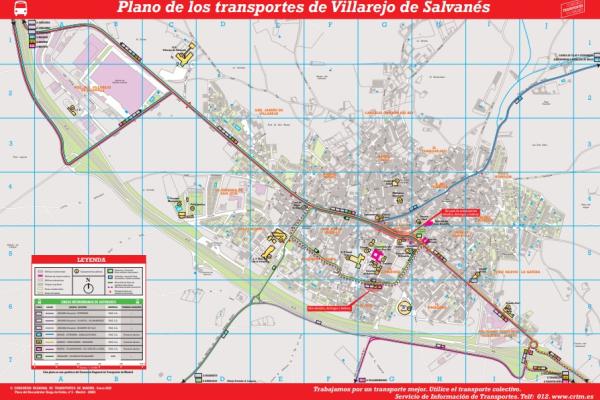
Una vez en la localidad, el movimiento por su casco histórico —presidido por su imponente Castillo y la Iglesia de San Andrés— se realiza de forma cómoda y preferentemente peatonal. Las paradas de autobús se encuentran situadas estratégicamente en las vías principales que circundan el centro urbano para facilitar el acceso de vecinos y visitantes a los comercios, centros educativos y monumentos locales. Para quienes acceden en vehículo privado, el municipio cuenta con amplias zonas de estacionamiento libre en los accesos para evitar la saturación de las calles céntricas.
Para planificar su viaje con mayor precisión y conocer la ubicación exacta de las paradas y frecuencias, descarga los mapas de transporte oficiales disponibles en esta sección. Contar con estos planos en su dispositivo le permitirá optimizar sus desplazamientos y disfrutar de Villarejo de Salvanés con total comodidad.
 Mapa de Villarejo de Salvanés
A new window will open