

Birdwatching in Madrid: Bird and Nature Observation
Discover Madrid’s biodiversity
The region of Madrid is a region of contrasting landscapes, biodiversity and natural spaces of high ecological interest.
39.9% of its surface is protected thanks to a great diversity of ecosystems and habitats (high mountains, pine forests, meadows, pastures and riparian forests). The presence of about 240 species of birds (of the approximately 400 in Spain) with key species such as the Imperial Eagle or the Black Vulture, and the declaration of the Guadarrama National Park, give the region a great potential as a quality ornithological destination.
Learn more: Madrid Bird Watching
Attachments:
A new window will open
La Red de Observatorios de Fauna de la Comunidad de Madrid
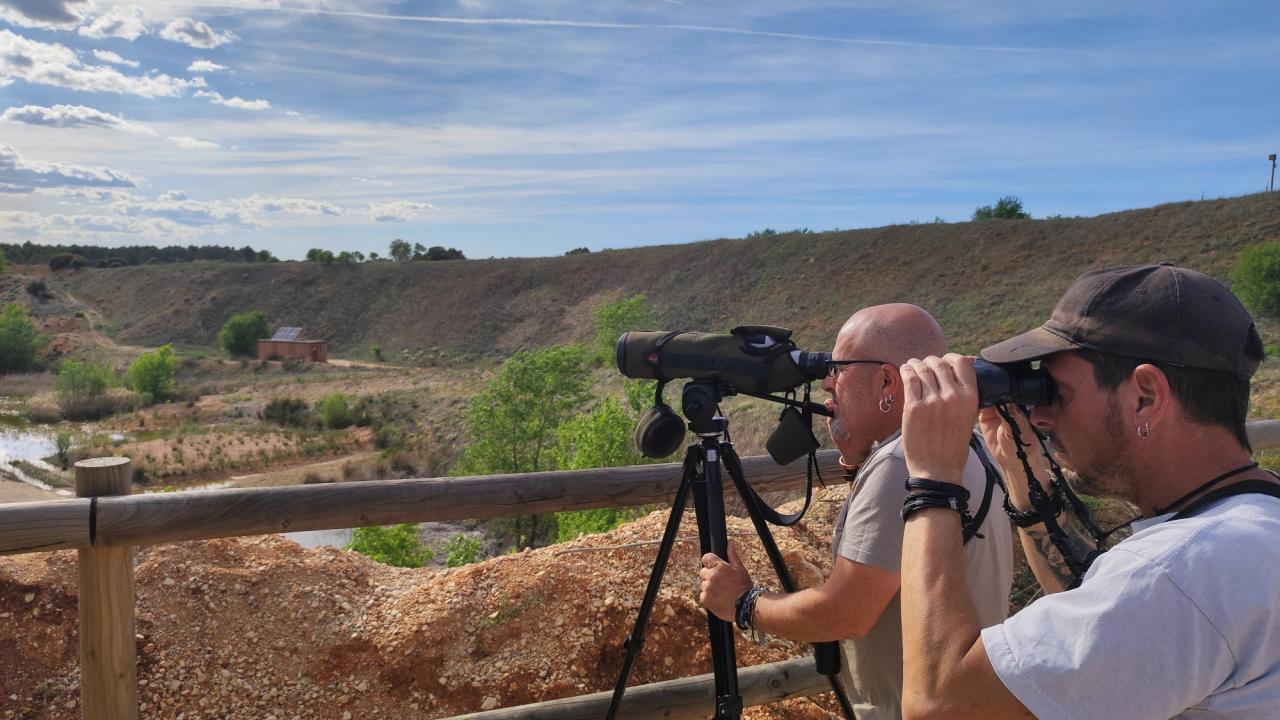
Para los aficionados al birdwatching y a la fotografía de naturaleza, la región dispone de la Red de Observatorios de Fauna de la Comunidad de Madrid. Esta infraestructura abarca una amplia variedad de equipamientos situados en los Espacios Naturales Protegidos de la región:
- Casetas de observación y hides: Diseñados para camuflarse en el entorno y fotografiar o contemplar las especies sin interferir en su hábitat.
- Miradores elevados y torres de avistamiento: Ubicados en puntos estratégicos con panorámicas despejadas sobre humedales, cantiles rocosos y dehesas.
- Paneles interpretativos y rutas señalizadas: Equipados con información visual para identificar fácilmente las aves autóctonas y migratorias en cada estación del año.
Principales Zonas de Avistamiento
Esta red permite observar una gran biodiversidad de avifauna a lo largo de toda la geografía madrileña:
- Humedales y Lagunas del Sur: Puntos clave para el avistamiento de aves acuáticas, garzas y flamencos (como el Parque Regional del Sureste).
- Sierra de Guadarrama y dehesas: Espacios idóneos para la observación de grandes rapaces, como el águila imperial ibérica y el buitre negro.
-
Campiñas y sotos fluviales: Zonas de especial protección (ZEPA) donde habitan avutardas, cernícalos y aves esteparias.
Sustainable tourism and bird conservation

The Mediterranean Forest: The Domains of the Iberian Imperial Eagle
In Madrid this habitat can be observed in all its splendor in large areas of the region. For this reason, one of the best populations of Iberian imperial eagles in the world is preserved here, which, despite being one of the most endangered birds of prey on the planet, has pairs nesting just a few kilometers from the capital.
In addition to the Iberian imperial eagle, Madrid offers opportunities to observe other species that will make the "birdwatcher" happy; black stork, booted eagle, black kite and red kite, red-necked nightjar, eagle owl, scops owl, scops owl, dartford swallow, bee-eater, dartford warbler, blackcap, among many other species and all this in a unique landscape environment.

The Mountain: In search of the Bluethroat
It is above the growth limit of the trees, among the scrub and mountain pastures, where we can discover the beautiful blue-breasted nightingale, when in spring the males engage in a singing and displaying competition from the top of the scrub.
The mountain areas are home to a large number of species, some like the red rock thrush, the alpine pipit or the greenfinch prefer the higher areas covered by grasses or rocky areas, while others like the autillo, the oriole, the crossbill, the crossbill, the crested tit or the pied flycatcher, prefer the forests that extend along the slopes. The presence of birds of prey is also remarkable, such as the black vulture and the griffon vulture, the golden eagle, the booted eagle, or the red kite, among others.

Steppes: The Winged Giants of the Plains
It is on the broad cultivated plains that flocks of bustards find a place to live. Watching the nuptial stopover of dozens of males, displaying themselves in the spectacular "wheel", is one of the great ornithological spectacles that should be seen at least once in a lifetime.
The same fields where the bustards roam are home to other species equally adapted to living in steppe environments. Birds such as the Montagu's harrier, the lesser kestrel, the little bustard, the Iberian sandgrouse and the black-bellied sandgrouse, the calandra lark, the Crested Lark and the Crested Lark, or the common ground-tyrant populate the open areas of the region. Areas covered by low scrub or small rocks are good places to look for the Dartford Warbler or the curious Black Wheatear.

Wetlands and Riveras: A Blue Spot on the Shore
Although natural lagoons are very scarce in the region, the proliferation of gravel pits has given rise after their abandonment to a large number of "artificial lagoons" that have been rapidly occupied by various aquatic species.
The rivers, thanks to their permanent humidity, become refuges of biodiversity as they flow through territories subjected to severe summer drought.
It is among the dense marshy vegetation of lagoons and gravel pits, where a unique bird, the Purple Gallinule, appears before our eyes, showing off its spectacular metallic blue plumage in contrast to its thick beak and robust red legs.
In the groves that surround the rivers and lagoons is frequent the moscón bird, among an endless number of small birds. The lagoons are frequented by the little bittern, the calamon, the marsh harrier, the great crested grebe, the black-necked grebe and the reed warbler. Anatidae such as the spoon-billed spoonbill or the scarcer ruddy duck, among many others, can be seen in the wetlands of the region, with the brown pochard being a sporadic visitor to these environments.

Urban Parks: Trees that Hide Wildlife
The Urban Parks present a varied and surprising avifauna, where in addition to an endless number of small birds, we can locate diurnal birds of prey that are attracted by the abundance of prey such as the goshawk, the sparrowhawk or the kestrel as well as nocturnal birds of prey such as the little owl and the scops owl.

Madrid goes on the road
Visit one of the 28 Ornithological Routes designed on the Network of Livestock Trails, which run through the different ecosystems. To enjoy it more completely download the Ornivias app.
Preguntas Frecuentes sobre la Observación de Aves en Madrid (FAQ)
¿Cuál es la mejor época del año para hacer birdwatching en la Comunidad de Madrid?
La Comunidad de Madrid ofrece excelentes oportunidades de avistamiento durante todo el año, aunque las estaciones clave son la primavera y el invierno. La primavera (de marzo a junio) es la mejor época para contemplar el cortejo, el canto y el plumaje de celo de las especies reproductoras e invernantes migratorias. Por su parte, los meses de invierno son ideales para la observación de acuáticas e invernantes en los humedales del sur y en los embalses de la región.
¿Cuáles son las especies de aves más emblemáticas que se pueden ver en Madrid?
Entre las joyas ornitológicas de la región destacan el águila imperial ibérica (una de las aves rapaces más amenazadas del mundo), el buitre negro (con importantes colonias en la Sierra de Guadarrama), la avutarda euroasiática en las estepas del cereal, el elanio común, el cernícalo primilla y la cigüeña blanca.
¿Dónde se pueden ver grandes rapaces cerca de la capital?
Los mejores entornos para divisar grandes rapaces como el águila imperial, el buitre negro o el águila real son los Espacios Protegidos de la Sierra de Guadarrama, el Valle del Lozoya, el Parque Regional del Curso Medio del Río Guadarrama y el Monte de El Pardo (desde sus miradores perimetrales habilitados).
¿Es necesario contratar un guía especializado para observar aves?
Aunque es posible realizar itinerarios por libre en las rutas y miradores señalizados de la región, contratar los servicios de un guía ornitológico local o acudir con empresas de ecoturismo mejora notablemente la experiencia. Un guía certificado facilita el uso de material óptico de alta gama (telescopios terrestres), conoce los puntos exactos de avistamiento según la época y garantiza un comportamiento ético y respetuoso con la fauna.
¿Qué material básico se recomienda llevar para una salida ornitológica?
Para disfrutar plenamente de la jornada se recomienda llevar prismáticos (los de formato 8x42 o 10x42 son los más polivalentes), calzado cómodo de senderismo, ropa de colores neutros o mimetizados (evitando tonos brillantes para no asustar a las aves), agua, protección solar y una guía de campo de aves en formato papel o app móvil.
¿Qué otras actividades de naturaleza y aventura se pueden combinar en la región?
La observación de aves se puede integrar fácilmente con rutas de senderismo, fotografía de naturaleza, rutas en bicicleta de montaña o visitas al patrimonio histórico de los municipios madrileños. Para explorar todas las opciones de ocio al aire libre en la región, puedes consultar nuestra sección principal de Deporte y Turismo activo.


